Greetings from Mongolia

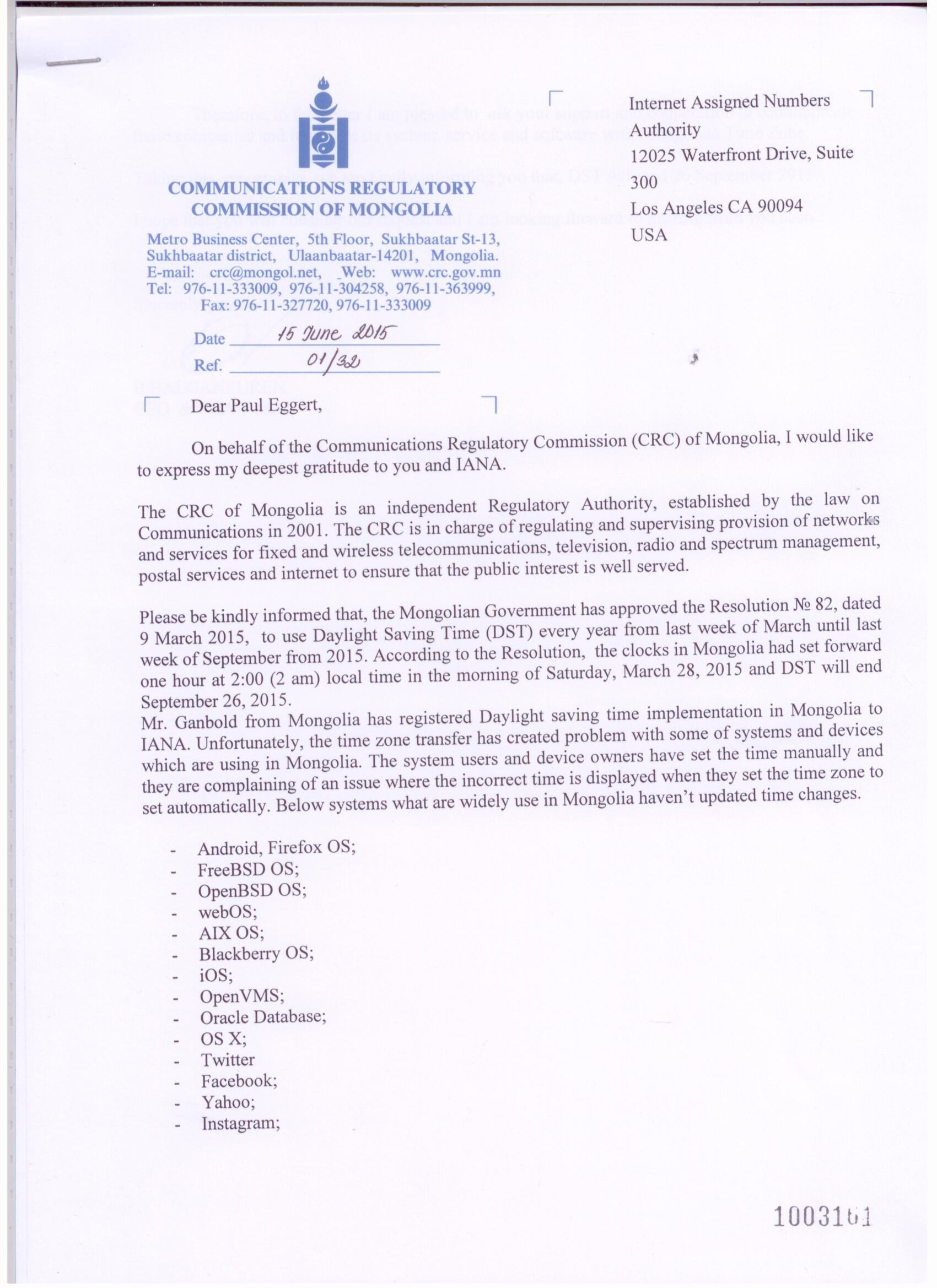
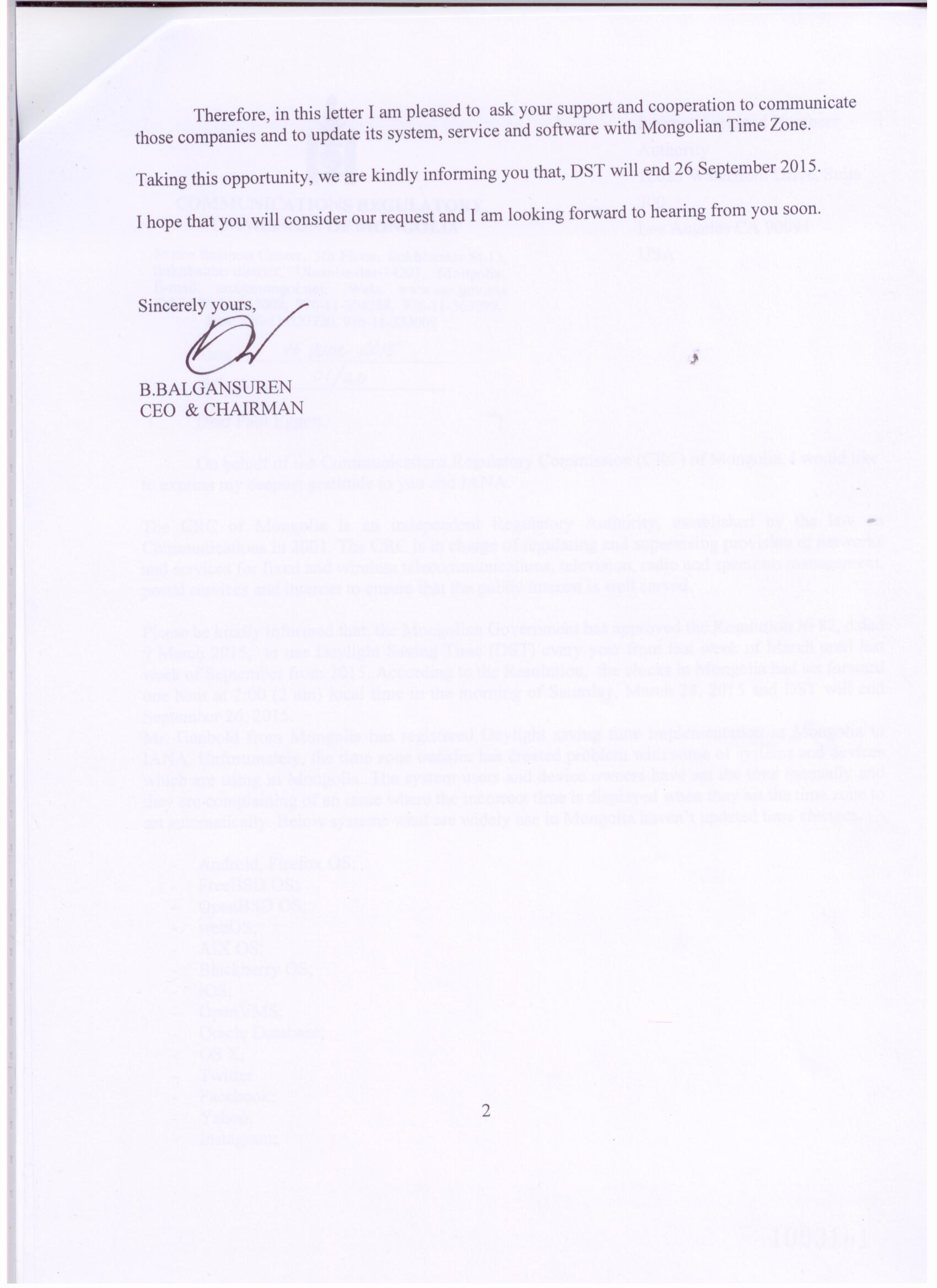
Dear Paul Eggert, Greetings from Mongolia. I am writing this letter on behalf of the Communications Regulatory Commission of Mongolia. The Mongolian Government has approved the Resolution ? 82, dated 09 March 2015, to use Daylight Saving Time (DST) every year from last week of March until last week of September from 2015. According to the Resolution, the clocks in Mongolia has set forward one hour at 2 : 00 (2 am) local time. Unfortunately, some of system, service and software which are widely using in Mongolia have not updated their time zone. Regarding this issue, the CRC has sent you official letter dated 15th June 2015 to you for your support on above mentioned issue and we have not received any response from you yet. Here I attached the copy of letter. Thank you for your understanding. I look forward hearing from you soon. BR, Amgalan Ts. (Ms) Foreign Relation Officer, Legal, Information and Administration Dept, CRC of Mongolia. mobile: 976 91112268 phone: 976 11 304258,304257 fax:976 11 327720 e-mail: amgalants@crc.gov.mn<mailto:amgalants@crc.gov.mn>

Dear Ms Amgalan Ts., The current version of the timezone database has the following transitions for 2015: Asia/Ulaanbaatar Fri Mar 27 17:59:59 2015 UT = Sat Mar 28 01:59:59 2015 ULAT isdst=0 gmtoff=28800 Asia/Ulaanbaatar Fri Mar 27 18:00:00 2015 UT = Sat Mar 28 03:00:00 2015 ULAST isdst=1 gmtoff=32400 Asia/Ulaanbaatar Fri Sep 25 14:59:59 2015 UT = Fri Sep 25 23:59:59 2015 ULAST isdst=1 gmtoff=32400 Asia/Ulaanbaatar Fri Sep 25 15:00:00 2015 UT = Fri Sep 25 23:00:00 2015 ULAT isdst=0 gmtoff=28800 It shows clocks going forwards at 2am on March 28th, and back at 00:00 (midnight) on Saturday September 25th. Is this not correct? for future years, the transitions are stored as: Asia/Ulaanbaatar Fri Mar 25 17:59:59 2016 UT = Sat Mar 26 01:59:59 2016 ULAT isdst=0 gmtoff=28800 Asia/Ulaanbaatar Fri Mar 25 18:00:00 2016 UT = Sat Mar 26 03:00:00 2016 ULAST isdst=1 gmtoff=32400 Asia/Ulaanbaatar Fri Sep 23 14:59:59 2016 UT = Fri Sep 23 23:59:59 2016 ULAST isdst=1 gmtoff=32400 Asia/Ulaanbaatar Fri Sep 23 15:00:00 2016 UT = Fri Sep 23 23:00:00 2016 ULAT isdst=0 gmtoff=28800 Asia/Ulaanbaatar Fri Mar 24 17:59:59 2017 UT = Sat Mar 25 01:59:59 2017 ULAT isdst=0 gmtoff=28800 Asia/Ulaanbaatar Fri Mar 24 18:00:00 2017 UT = Sat Mar 25 03:00:00 2017 ULAST isdst=1 gmtoff=32400 Asia/Ulaanbaatar Fri Sep 29 14:59:59 2017 UT = Fri Sep 29 23:59:59 2017 ULAST isdst=1 gmtoff=32400 Asia/Ulaanbaatar Fri Sep 29 15:00:00 2017 UT = Fri Sep 29 23:00:00 2017 ULAT isdst=0 gmtoff=28800 Asia/Ulaanbaatar Fri Mar 30 17:59:59 2018 UT = Sat Mar 31 01:59:59 2018 ULAT isdst=0 gmtoff=28800 Asia/Ulaanbaatar Fri Mar 30 18:00:00 2018 UT = Sat Mar 31 03:00:00 2018 ULAST isdst=1 gmtoff=32400 Asia/Ulaanbaatar Fri Sep 28 14:59:59 2018 UT = Fri Sep 28 23:59:59 2018 ULAST isdst=1 gmtoff=32400 Asia/Ulaanbaatar Fri Sep 28 15:00:00 2018 UT = Fri Sep 28 23:00:00 2018 ULAT isdst=0 gmtoff=28800 with kind regards, Derick On Thu, 2 Jul 2015, amgalan tsogtgerel wrote:
Dear Paul Eggert,
Greetings from Mongolia.
I am writing this letter on behalf of the Communications Regulatory Commission of Mongolia.
The Mongolian Government has approved the Resolution ? 82, dated 09 March 2015, to use Daylight Saving Time (DST) every year from last week of March until last week of September from 2015. According to the Resolution, the clocks in Mongolia has set forward one hour at 2 : 00 (2 am) local time. Unfortunately, some of system, service and software which are widely using in Mongolia have not updated their time zone.
Regarding this issue, the CRC has sent you official letter dated 15th June 2015 to you for your support on above mentioned issue and we have not received any response from you yet.
Here I attached the copy of letter.
Thank you for your understanding.
I look forward hearing from you soon.
BR, Amgalan Ts. (Ms) Foreign Relation Officer, Legal, Information and Administration Dept, CRC of Mongolia. mobile: 976 91112268 phone: 976 11 304258,304257 fax:976 11 327720 e-mail: amgalants@crc.gov.mn<mailto:amgalants@crc.gov.mn>
-- http://derickrethans.nl | http://xdebug.org Like Xdebug? Consider a donation: http://xdebug.org/donate.php twitter: @derickr and @xdebug Posted with an email client that doesn't mangle email: alpine

amgalan tsogtgerel wrote:
the CRC has sent you official letter dated 15th June 2015 to you for your support on above mentioned issue and we have not received any response from you yet.
I twice replied via email to crc@mongol.net, the email address mentioned in that official letter. Perhaps you're not getting those emails? Anyway, at the risk of repeating myself: Although the tz project and the IANA are doing their job, Apple and Google and etc. have messed up in Mongolia. I suggest that you write about this to Apple and Google and etc.; possibly you'll have more influence on them than I do. Please feel free to quote this email, particularly paragraph (B) below. I suggest also writing to the part of the Mongolian government responsible for daylight-saving time and mentioning paragraph (A). Here are more details about the issue. First, the Mongolian time change works for me on my desktop, which is running Ubuntu 15.04. I can run the following programs from my shell: $ TZ=Asia/Ulaanbaatar date; date -u Thu Jul 2 00:47:32 ULAST 2015 Wed Jul 1 15:47:32 UTC 2015 This correctly says Mongolian time is Ulaanbaatar Summer Time (ULAST), which is nine hours ahead of Coordinated Universal Time (UTC). It's also working that way for me on my main UCLA cluster, running CentOS 6.0 (a Red Hat clone released in 2011). Also, on another UCLA-based server, running Oracle Solaris 11.2 (released 2014). So it is working in some cases. But not all. I found one old server at work, running Solaris 10 (released 2005), which says Mongolian time is only eight hours ahead of UTC; this server's time zone tables haven't been updated since May 2012. More importantly, my son's cell phone and my cell phone have similar problems; they're running iOS 8.3 and Android 5.1.1 (both are current versions released April 2015); apparently Apple and Google did not update their operating systems' time zone tables before releasing them and have not patched them since release. Undoubtedly this is what Mongolian users are complaining about. Before talking about how to fix things, let me describe how the process worked and/or is not working: 1. The Mongolian government decided on 2015-03-09 to use daylight saving time starting 2015-03-28 03:00 local time. 2. Ganbold Tsagaankhuu (affiliation unknown) privately sent me email dated 2015-03-10 notifying me of the change. 3. We published an experimental patch dated 2015-03-10 00:03:48 -0700 containing the change; you can see its archived announcement at <http://mm.icann.org/pipermail/tz/2015-March/022073.html>. 4. We published an official release 2015b dated 2015-03-19 23:28:11 2015 -0700 containing the change; you can see its archived announcement at <http://mm.icann.org/pipermail/tz-announce/2015-March/000029.html>. 5. Suppliers of operating systems eventually pick up these changes and release new operating system releases and/or patches to their existing systems. Known operating systems include GNU/Linux distributions like Red Hat and Ubuntu, and many other systems including Android (Google), Firefox OS, FreeBSD, NetBSD, OpenBSD, Cygwin, DJGPP, MINIX, webOS (LG), AIX (IBM), BlackBerry 10, iOS (Apple), Microsoft Windows, OpenVMS (HP), Oracle Database, Oracle Solaris, and OS X (Apple). (There are undoubtedly other operating systems that we don't know about.) From the above examples, we know that Android and iOS have not been updated, whereas Red Hat and Solaris and Ubuntu have been. 6. Users of these operating systems eventually install patches to bring their systems up to date. For proprietary systems this often requires support contracts. Steps (5) and (6) haven't been completed properly in Mongolia; that is, the Mongolian systems in question are like my older server at work (where step (6) hasn't been done), or are like Apple or Android cell phones (where step (5) hasn't been done). Here are some ways to improve this process the next time the Mongolian government changes its time zone rules. A. The Mongolian government can announce the change well before it occurs. Eighteen days is not enough. I suggest six months or more. The last time the rules were changed in the US, the federal government gave nineteen months' notice. B. Operating system suppliers can be more timely about propagating the changes to their operating systems. My desktop contains all the changes of tz release 2015d (dated April 24); why doesn't my cell phone? Apple and Google should have the current tz version in their current cell phone releases and should send over-the-air patches in a timely way. C. Operating system users in Mongolia can be more diligent about installing patches. Users regularly employing over-the-network updates (which is good practice anyway) should have no problems. D. The Internet Engineering Task Force has drafted the specifications for a time zone data distribution service that should automate steps (B) and (C) more rapidly. See <https://tools.ietf.org/html/draft-ietf-tzdist-service-09> (2015-06-29). My impression is that Apple will implement this service, and perhaps other suppliers will do something similar. However, it's just a draft and is not widely implemented so this is somewhat speculative. PS. This problem is not unique to Mongolia. We have similar problems in Uruguay later this year (fix not yet officially released), in Egypt this year (fixed in tz release 2015d dated 2015-04-24 08:09:46 -0700), in Chile and Mexico this year (fixed in tz release 2015a dated 2015-01-29 22:35:20 -0800), etc.
I have confirmed that the Mongolian daylight-saving problem has been fixed in iOS release 8.4, dated 2015-06-30. This is the operating system used on Apple iPhone and iPad. Users in Mongolia who update to the latest iOS release should get the correct times now.

On 2015-07-03 08:45, Paul Eggert wrote:
amgalan tsogtgerel wrote:
the CRC has sent you official letter dated 15th June 2015 to you for your support on above mentioned issue and we have not received any response from you yet.
I twice replied via email to crc@mongol.net, the email address mentioned in that official letter. Perhaps you're not getting those emails? Anyway, at the risk of repeating myself: Although the tz project and the IANA are doing their job, Apple and Google and etc. have messed up in Mongolia. I suggest that you write about this to Apple and Google and etc.; possibly you'll have more influence on them than I do. Please feel free to quote this email, particularly paragraph (B) below. I suggest also writing to the part of the Mongolian government responsible for daylight-saving time and mentioning paragraph (A).
Before talking about how to fix things, let me describe how the process worked and/or is not working: 1. The Mongolian government decided on 2015-03-09 to use daylight saving time starting 2015-03-28 03:00 local time. 2. Ganbold Tsagaankhuu (affiliation unknown) privately sent me email dated 2015-03-10 notifying me of the change. 3. We published an experimental patch dated 2015-03-10 00:03:48 -0700 containing the change; you can see its archived announcement at <http://mm.icann.org/pipermail/tz/2015-March/022073.html>. 4. We published an official release 2015b dated 2015-03-19 23:28:11 2015 -0700 containing the change; you can see its archived announcement at <http://mm.icann.org/pipermail/tz-announce/2015-March/000029.html>. 5. Suppliers of operating systems eventually pick up these changes and release new operating system releases and/or patches to their existing systems. Known operating systems include GNU/Linux distributions like Red Hat and Ubuntu, and many other systems including Android (Google), Firefox OS, FreeBSD, NetBSD, OpenBSD, Cygwin, DJGPP, MINIX, webOS (LG), AIX (IBM), BlackBerry 10, iOS (Apple), Microsoft Windows, OpenVMS (HP), Oracle Database, Oracle Solaris, and OS X (Apple). (There are undoubtedly other operating systems that we don't know about.) From the above examples, we know that Android and iOS have not been updated, whereas Red Hat and Solaris and Ubuntu have been. 6. Users of these operating systems eventually install patches to bring their systems up to date. For proprietary systems this often requires support contracts. Steps (5) and (6) haven't been completed properly in Mongolia; that is, the Mongolian systems in question are like my older server at work (where step (6) hasn't been done), or are like Apple or Android cell phones (where step (5) hasn't been done).
Here are some ways to improve this process the next time the Mongolian government changes its time zone rules. A. The Mongolian government can announce the change well before it occurs. Eighteen days is not enough. I suggest six months or more. The last time the rules were changed in the US, the federal government gave nineteen months' notice. B. Operating system suppliers can be more timely about propagating the changes to their operating systems. My desktop contains all the changes of tz release 2015d (dated April 24); why doesn't my cell phone? Apple and Google should have the current tz version in their current cell phone releases and should send over-the-air patches in a timely way. C. Operating system users in Mongolia can be more diligent about installing patches. Users regularly employing over-the-network updates (which is good practice anyway) should have no problems. D. The Internet Engineering Task Force has drafted the specifications for a time zone data distribution service that should automate steps (B) and (C) more rapidly. See <https://tools.ietf.org/html/draft-ietf-tzdist-service-09> (2015-06-29). My impression is that Apple will implement this service, and perhaps other suppliers will do something similar. However, it's just a draft and is not widely implemented so this is somewhat speculative. PS. This problem is not unique to Mongolia. We have similar problems in Uruguay later this year (fix not yet officially released), in Egypt this year (fixed in tz release 2015d dated 2015-04-24 08:09:46 -0700), in Chile and Mexico this year (fixed in tz release 2015a dated 2015-01-29 22:35:20 -0800), etc.>
See https://support.microsoft.com/en-ca/gp/cp_dst for MS policy requiring 4-6 months notice prior to December annual or August/September interim tz updates. Other MS changes may be released as retail updates or downloadable hotfixes depending probably on official support requests. MS does not use IANA tz info so official letters should also be copied to MS; some DB and development product vendors also do not use IANA tz info, so e.g. Oracle should also be copied to update DBs and Java; add other product vendors and orgs which you find using outdated info. -- Take care. Thanks, Brian Inglis

Why don't MS and Oracle use the IANA tz file? Seems like a waste of effort. Surely they at least crib the IANA for hints on updates. On Jul 3, 2015 8:32 PM, "Brian Inglis" <Brian.Inglis@systematicsw.ab.ca> wrote:
On 2015-07-03 08:45, Paul Eggert wrote:
amgalan tsogtgerel wrote:
the CRC has sent you official letter dated 15th June 2015 to you for your support on above mentioned issue and we have not received any response from you yet.
I twice replied via email to crc@mongol.net, the email address mentioned in that official letter. Perhaps you're not getting those emails? Anyway, at the risk of repeating myself: Although the tz project and the IANA are doing their job, Apple and Google and etc. have messed up in Mongolia. I suggest that you write about this to Apple and Google and etc.; possibly you'll have more influence on them than I do. Please feel free to quote this email, particularly paragraph (B) below. I suggest also writing to the part of the Mongolian government responsible for daylight-saving time and mentioning paragraph (A).
Before talking about how to fix things, let me describe how the process
worked and/or is not working: 1. The Mongolian government decided on 2015-03-09 to use daylight saving time starting 2015-03-28 03:00 local time. 2. Ganbold Tsagaankhuu (affiliation unknown) privately sent me email dated 2015-03-10 notifying me of the change. 3. We published an experimental patch dated 2015-03-10 00:03:48 -0700 containing the change; you can see its archived announcement at < http://mm.icann.org/pipermail/tz/2015-March/022073.html>. 4. We published an official release 2015b dated 2015-03-19 23:28:11 2015 -0700 containing the change; you can see its archived announcement at < http://mm.icann.org/pipermail/tz-announce/2015-March/000029.html>. 5. Suppliers of operating systems eventually pick up these changes and release new operating system releases and/or patches to their existing systems. Known operating systems include GNU/Linux distributions like Red Hat and Ubuntu, and many other systems including Android (Google), Firefox OS, FreeBSD, NetBSD, OpenBSD, Cygwin, DJGPP, MINIX, webOS (LG), AIX (IBM), BlackBerry 10, iOS (Apple), Microsoft Windows, OpenVMS (HP), Oracle Database, Oracle Solaris, and OS X (Apple). (There are undoubtedly other operating systems that we don't know about.) From the above examples, we know that Android and iOS have not been updated, whereas Red Hat and Solaris and Ubuntu have been. 6. Users of these operating systems eventually install patches to bring their systems up to date. For proprietary systems this often requires support contracts. Steps (5) and (6) haven't been completed properly in Mongolia; that is, the Mongolian systems in question are like my older server at work (where step (6) hasn't been done), or are like Apple or Android cell phones (where step (5) hasn't been done).
Here are some ways to improve this process the next time the Mongolian
government changes its time zone rules. A. The Mongolian government can announce the change well before it occurs. Eighteen days is not enough. I suggest six months or more. The last time the rules were changed in the US, the federal government gave nineteen months' notice. B. Operating system suppliers can be more timely about propagating the changes to their operating systems. My desktop contains all the changes of tz release 2015d (dated April 24); why doesn't my cell phone? Apple and Google should have the current tz version in their current cell phone releases and should send over-the-air patches in a timely way. C. Operating system users in Mongolia can be more diligent about installing patches. Users regularly employing over-the-network updates (which is good practice anyway) should have no problems. D. The Internet Engineering Task Force has drafted the specifications for a time zone data distribution service that should automate steps (B) and (C) more rapidly. See <https://tools.ietf.org/html/draft-ietf-tzdist-service-09> (2015-06-29). My impression is that Apple will implement this service, and perhaps other suppliers will do something similar. However, it's just a draft and is not widely implemented so this is somewhat speculative. PS. This problem is not unique to Mongolia. We have similar problems in Uruguay later this year (fix not yet officially released), in Egypt this year (fixed in tz release 2015d dated 2015-04-24 08:09:46 -0700), in Chile and Mexico this year (fixed in tz release 2015a dated 2015-01-29 22:35:20 -0800), etc.>
See https://support.microsoft.com/en-ca/gp/cp_dst for MS policy requiring 4-6 months notice prior to December annual or August/September interim tz updates. Other MS changes may be released as retail updates or downloadable hotfixes depending probably on official support requests. MS does not use IANA tz info so official letters should also be copied to MS; some DB and development product vendors also do not use IANA tz info, so e.g. Oracle should also be copied to update DBs and Java; add other product vendors and orgs which you find using outdated info.
-- Take care. Thanks, Brian Inglis

Oracle uses the IANA data. It’s currently only Microsoft that doesn’t – at least not everywhere. Microsoft has a long history of using their own time zones in the Windows operating system, which has affected other Microsoft technologies, such as the .NET Framework, Outlook, Exchange, Bing, and others. This compatibility issue is the main reason they don’t use the tz database at the core level. There is a team at Microsoft that maintains the data, and publishes hotfixes and cumulative updates to Windows Update and are listed at http://microsoft.com/time. They do pay attention to external sources, but ultimately their decisions are based on confirmation from official government sources. This is unlike the tzdb, which often takes action based on credible unofficial sources such as news websites. Full disclosure: I work for Microsoft. I don’t speak on behalf of the company, and I don’t work on that particular team, but yes – on occasion I do inform them of some of the learnings from this public discussion. They usually already know. With regard to Mongolia, Microsoft issued a hotfix in KB3049874 back in March: https://support.microsoft.com/en-us/kb/3049874 That said, there are some parts of Microsoft that do use IANA time zones. For example, applications that target the Windows Runtime (aka WinRT / Windows Store Applications) have the Windows.Globalization.Calendar and Windows.Globalization.DateTimeFormatting.DateTimeFormatter classes, both of which uses IANA time zones, not the traditional Microsoft time zones. Hope that helps . -Matt From: tz-bounces@iana.org [mailto:tz-bounces@iana.org] On Behalf Of Paul Ganssle Sent: Friday, July 3, 2015 5:40 PM To: Brian.Inglis@systematicsw.ab.ca Cc: tz@iana.org List Subject: Re: [tz] Greetings from Mongolia Why don't MS and Oracle use the IANA tz file? Seems like a waste of effort. Surely they at least crib the IANA for hints on updates. On Jul 3, 2015 8:32 PM, "Brian Inglis" <Brian.Inglis@systematicsw.ab.ca <mailto:Brian.Inglis@systematicsw.ab.ca> > wrote: On 2015-07-03 08:45, Paul Eggert wrote: amgalan tsogtgerel wrote: the CRC has sent you official letter dated 15th June 2015 to you for your support on above mentioned issue and we have not received any response from you yet. I twice replied via email to crc@mongol.net <mailto:crc@mongol.net> , the email address mentioned in that official letter. Perhaps you're not getting those emails? Anyway, at the risk of repeating myself: Although the tz project and the IANA are doing their job, Apple and Google and etc. have messed up in Mongolia. I suggest that you write about this to Apple and Google and etc.; possibly you'll have more influence on them than I do. Please feel free to quote this email, particularly paragraph (B) below. I suggest also writing to the part of the Mongolian government responsible for daylight-saving time and mentioning paragraph (A). Before talking about how to fix things, let me describe how the process worked and/or is not working: 1. The Mongolian government decided on 2015-03-09 to use daylight saving time starting 2015-03-28 03:00 local time. 2. Ganbold Tsagaankhuu (affiliation unknown) privately sent me email dated 2015-03-10 notifying me of the change. 3. We published an experimental patch dated 2015-03-10 00:03:48 -0700 containing the change; you can see its archived announcement at <http://mm.icann.org/pipermail/tz/2015-March/022073.html>. 4. We published an official release 2015b dated 2015-03-19 23:28:11 2015 -0700 containing the change; you can see its archived announcement at <http://mm.icann.org/pipermail/tz-announce/2015-March/000029.html>. 5. Suppliers of operating systems eventually pick up these changes and release new operating system releases and/or patches to their existing systems. Known operating systems include GNU/Linux distributions like Red Hat and Ubuntu, and many other systems including Android (Google), Firefox OS, FreeBSD, NetBSD, OpenBSD, Cygwin, DJGPP, MINIX, webOS (LG), AIX (IBM), BlackBerry 10, iOS (Apple), Microsoft Windows, OpenVMS (HP), Oracle Database, Oracle Solaris, and OS X (Apple). (There are undoubtedly other operating systems that we don't know about.) From the above examples, we know that Android and iOS have not been updated, whereas Red Hat and Solaris and Ubuntu have been. 6. Users of these operating systems eventually install patches to bring their systems up to date. For proprietary systems this often requires support contracts. Steps (5) and (6) haven't been completed properly in Mongolia; that is, the Mongolian systems in question are like my older server at work (where step (6) hasn't been done), or are like Apple or Android cell phones (where step (5) hasn't been done). Here are some ways to improve this process the next time the Mongolian government changes its time zone rules. A. The Mongolian government can announce the change well before it occurs. Eighteen days is not enough. I suggest six months or more. The last time the rules were changed in the US, the federal government gave nineteen months' notice. B. Operating system suppliers can be more timely about propagating the changes to their operating systems. My desktop contains all the changes of tz release 2015d (dated April 24); why doesn't my cell phone? Apple and Google should have the current tz version in their current cell phone releases and should send over-the-air patches in a timely way. C. Operating system users in Mongolia can be more diligent about installing patches. Users regularly employing over-the-network updates (which is good practice anyway) should have no problems. D. The Internet Engineering Task Force has drafted the specifications for a time zone data distribution service that should automate steps (B) and (C) more rapidly. See <https://tools.ietf.org/html/draft-ietf-tzdist-service-09> (2015-06-29). My impression is that Apple will implement this service, and perhaps other suppliers will do something similar. However, it's just a draft and is not widely implemented so this is somewhat speculative. PS. This problem is not unique to Mongolia. We have similar problems in Uruguay later this year (fix not yet officially released), in Egypt this year (fixed in tz release 2015d dated 2015-04-24 08:09:46 -0700), in Chile and Mexico this year (fixed in tz release 2015a dated 2015-01-29 22:35:20 -0800), etc.> See https://support.microsoft.com/en-ca/gp/cp_dst for MS policy requiring 4-6 months notice prior to December annual or August/September interim tz updates. Other MS changes may be released as retail updates or downloadable hotfixes depending probably on official support requests. MS does not use IANA tz info so official letters should also be copied to MS; some DB and development product vendors also do not use IANA tz info, so e.g. Oracle should also be copied to update DBs and Java; add other product vendors and orgs which you find using outdated info. -- Take care. Thanks, Brian Inglis
Matt Johnson wrote:
Oracle uses the IANA data. It’s currently only Microsoft that doesn’t – at least not everywhere.
I think HP-UX is in a similar boat. That is, although HP-UX uses the IANA tz data, it also has a proprietary time zone database called tztab, originally developed independently from the tz project. As I understand things, HP continues to maintain tztab for backward-compatibility reasons, and there are mappings between tztab and tz names. Sources: tztab(4) man page for HP-UX <http://h20565.www2.hp.com/hpsc/doc/public/display?docId=emr_na-c02271674> HP-UX 11i Java - Timezone Problem with Customized tztab(4) Entry <http://support.hp.com/us-en/document/c02553874>

to avoid any confusion * Oracle RDBMS, EBS , Solaris and Java do use IANA tz info and we monitor this list * since tzupdater 2.0 people can use the latest TZdata for Java see www.oracle.com/technetwork/java/javase/tzdata-versions-138805.html * Oracle RDBMS and EBS consolidates this roughly in a 6 monthly cycle see note 412160.1 Updated DST Transitions and New Time Zones in Oracle RDBMS and OJVM Time Zone File Patches on our support website * Oracle Solaris also provides updates see note 1982859.1 Solaris Daylight Saving Time (DST) Updates for 2015 on our support website Gunther On 4/07/2015 2:17, Brian Inglis wrote:
some DB and development product vendors also do not use IANA tz info, so e.g. Oracle should also be copied to update DBs and Java;
participants (7)
-
 amgalan tsogtgerel
 -
 Brian Inglis
 -
 Derick Rethans
 -
 gunther vermeir
 -
 Matt Johnson
 -
 Paul Eggert
 -
 Paul Ganssle